
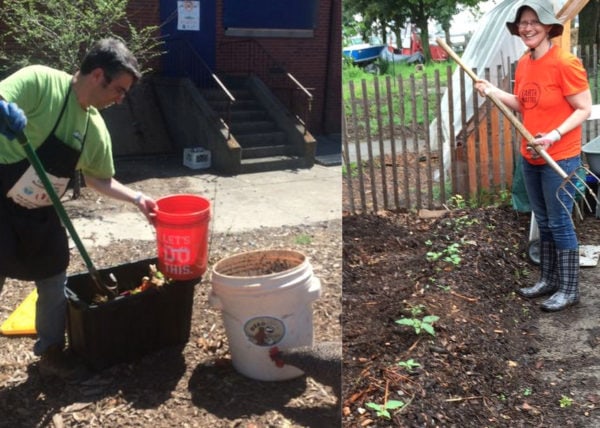
David Granik (left), seasonal apprentice, creating a batch of Bokashi. Marie Farrell (right), seasonal apprentice, trenches this two-week old batch of fermented food scrap in our Soil Start Farm’s lasagna compost bed.
by David Granik and friends
Bokashi composting is based on traditional agricultural practices, which originated among farmers in East Asia. The word “bokashi” is Japanese, and simply means “Fermented Organic Matter”.
This fermentation (pickling) process, naturally occurs as a result of the activity of several common species of microorganisms (where these microbes cause fermentation under anaerobic conditions), which are found in abundance in the human microbiome. These species were first isolated, combined, and cultured in the 1980s by Teruo Higa, who is considered by many to be the father of the modern bokashi method. He discovered that having three groups of microbes (lactic acid bacteria, yeast, and phototrophic bacteria) made bokashi a much more effective soil microbial inoculant and fermentation starter. These three groups of microbes together are referred to as Effective Microorganisms (EM).
In order for you to use the bokashi system in your home or garden today, you will need to either purchase the “bokashi sprinkles” or make your own.
Here are the “cliff notes” version of this ‘Do It Yourself” process which consists of the following items, some which can be purchased or found in your home:
- A bottle of these EM organisms (can be purchased online or at a local source)
- Blackstrap molasses and wheat bran
- Bucket with a close fitting lid
- Leaves
- A garden trowel
- A pot to plant in, or access to soil in the ground that could use amending!
- And, of course what we all have on hand every day!!!: FOOD SCRAPS!!
Bokashi Fermentation advocates claim that this system is beneficial for the following reasons:
- SPACE SAVER – Does not take up much space – generally 1’ x 1’ of floor or counter space is all you need.
- MINIMIZED ODER – Unpleasant odors (usually a vinegary/fermented smell) are minimized, especially since bokashi is kept closed in an airtight bucket.
- ALL FOOD SCRAPS CAN BE ‘CONVERTED” – Including meat and dairy, because the acidity of the end product suffices to kill off pathogenic bacteria.
- BOKASHI IS RICH IN NUTRIENTS – Finished bokashi adds beneficial microbes, bioavailable nutrients, and organic matter content.
- IT’S FAST! – Using the “Bokashi Sprinkles”, it takes just 2 weeks for food scraps to ferment, and an additional 2 weeks to trench. Then you can plant in this medium, or incorporate the dug up trenched materials into a compost system.
Find out more about the Bokashi system and how you can join the NYC Bokashi movement by joining us on Saturday, July 11 from 1-2:30 pm. Shig Matsukawa, our special guest and friend, will be leading a “how-to” demonstration at our Compost Learning Center.
Be sure to stick around because at 4 pm, there will be a potluck BBQ. We hope to see you there!