
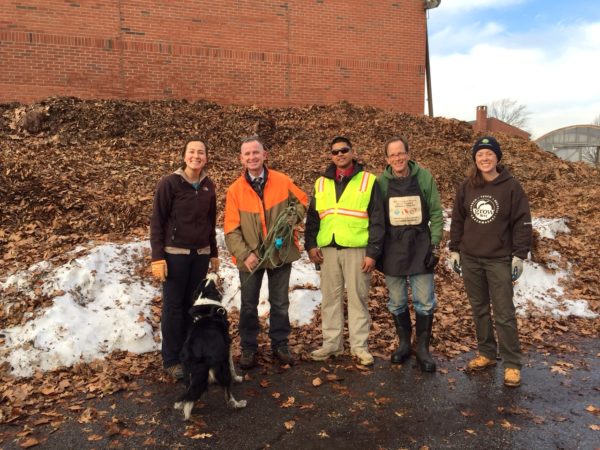
Representatives of Earth Matter’s Compost Learning Center partners, in front of a “brown mound” of GI-generated leaves. Representatives include, Marguerite Manela (NYC Compost Project Manager); Jim Reed, VJ Sookdeo and Max (TGI Park and Public Space staff and “the bird dog); Charlie (NYC Compost Project hosted by Earth Matter Operations Manager); and Sarah Beck, (GrowNYC Market Compost Manager).
By Charlie Bayrer and Marisa DeDominicis
Over the last 20 years many states across the country have enacted bans on the landfilling of grass clippings, leaves and other yard waste. This organic debris is recognized as a contributor to the production of greenhouse gases when disposed in a modern landfill. The bans are also meant to conserve space in local landfills and extend their life. Composting this material is seen as relatively simple, safe and cost effective. This is where many municipal and commercial composting operations got their start.
Today many municipalities, including New York City, are working to divert food scraps from landfill and into this same composting stream. These programs are driven by the high cost of (no longer local) landfill disposal, the lower cost of composting, and recognition of the nutrient value of organic waste. This shift of inputs is challenging for a traditional yard waste composting operation.
Earth Matter now finds itself in an equally challenging position, but looking at it from the opposite side. Earth Matter was born out of a Brooklyn food scrap recycling initiative. In 2005, a few community gardeners got together to voluntarily collect residential food scrap at the Fort Greene Farmers Market, and compost them in a consortium of five gardens. The Fort Greene Compost Project (FGCP) sought to reduce waste and have enhanced inputs for garden waste composting, ultimately diverting 1500 lbs. every week.
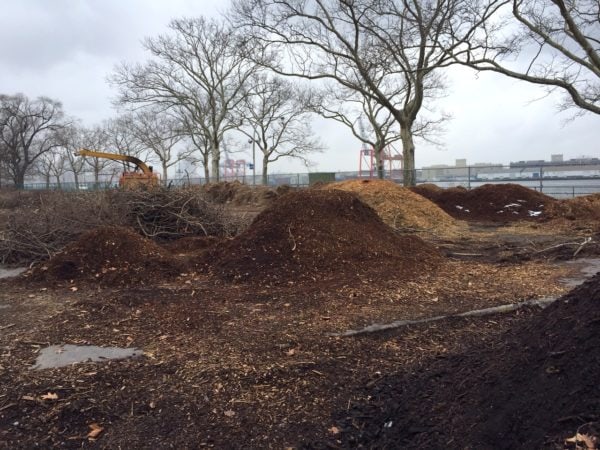
Earth Matter and TGI’s new, expanded “Pad #2” yard trimmings depot + processing site adjacent to Buttermilk Channel.
In 2009, when GrowNYC adopted the FGCP’s successful initiative, Earth Matter was incorporated and sought space on Governors Island to continue our mission of encouraging neighbor participation and leadership in composting. Our first home on GI was adjacent to “Brown Mound”, a 2,000 cubic yard mountain of leaves accumulated over 10 years near Picnic Point. The mountain was both a challenge and an inspiration for the vision of Zero Waste Island. While the mountain was beyond the scope of our work at the time, Earth Matter has processed the Island’s leaf waste since becoming part of the NYC Compost Project in 2012.
As more of Governors Island’s 172 acres becomes public parkland under the stewardship of the Trust for Governors Island (TGI), we have been asked to process a diverse range of plant debris, incorporating much of it into our more typical food scrap compost.
Jim Reed, TGI’s Director of Park and Public Space, estimates the landscape will produce 300+ cubic yards of leaf waste, 100+ cubic yards of perennial cutback, 100+ cubic yards of weed cutback, and 300 cubic yards of woody debris this year, in addition to a small amount of dry grass and goose manure swept off the lawns.
While Earth Matter and TGI horticultural staff are spending time chipping, shredding, and blending these materials, having them available allows for recipe variations that can be more specific to the compost end use (e.g. GI lawns, perennial beds, shrubs and trees).
We’re counting the days (85!) until we welcome the public back to the Compost Learning Center open hours. Later in the season, when The Hills and the Buttermilk Channel Promenade open, you’ll be able walk or bike past the newly expanded Pad 2 depot dedicated to processing yard waste!
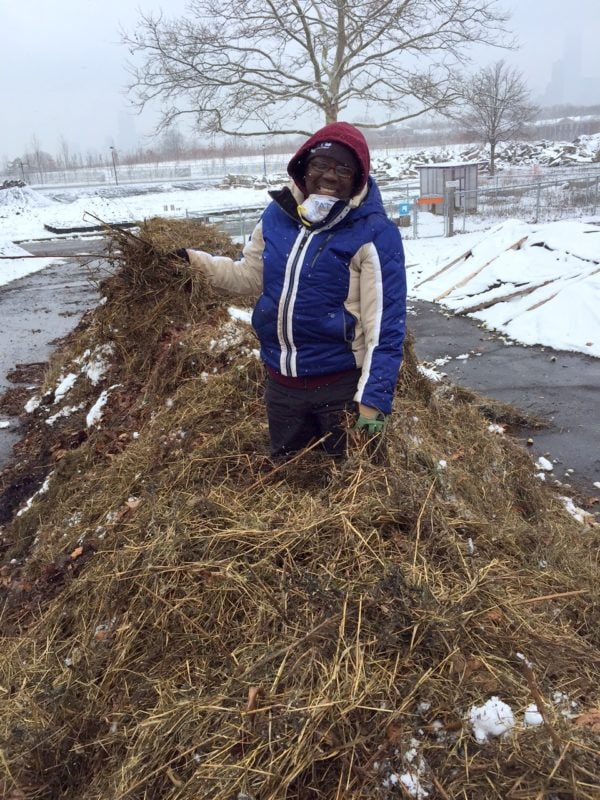
Pat Simmonds, compost operator trainee, spreads “cut back” plant stalks from Hammock Grove’s perennial understory on top of our latest compost windrow.