
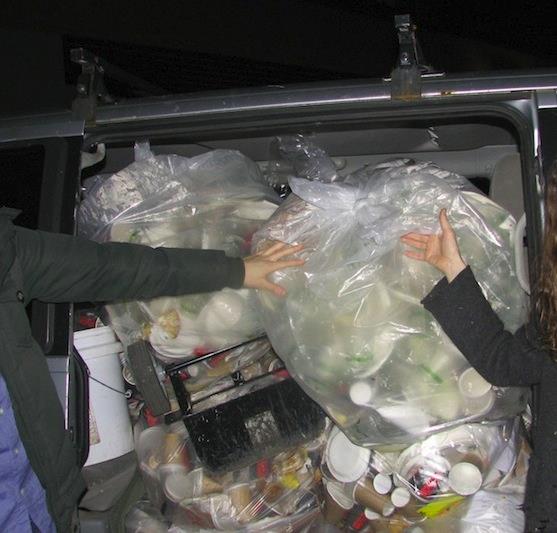
 536 lbs. of compostable serviceware from this year’s Just Food Conference
Most disposable, single-use serviceware (e.g., containers, cups, plates, cutlery, bags, etc.) ultimately ends up as landfill. The problem is amplified by the fact that a significant amount of serviceware is made from oil (petroleum) based plastics and Styrofoam, with an estimated 200,000 barrels of oil a day in the U.S. alone used in conventional plastic packaging, which includes, but is not limited to, plastic bags, serviceware, and other single-use items.
There has been a push in recent years to phase out Styrofoam and oil-based plastics used in serviceware and replace them with products made from materials that have a lower environmental impact and are derived from renewable resources. New materials now used in serviceware include bagasse (a by-product of sugar cane and sorghum juice extraction), paper, wheat straw, bamboo, palm fiber, corn starch, soy starch, tapioca starch, potato starch and biodegradable (aka compostable) plastics made from organic materials. While these product substitutions have had an overall positive impact on waste management, the role of biodegradable plastics in serviceware and its impact on the composting process is not without controversy.
Biodegradable plastics have existed since the late 1980s and they have been in the lives of Americans in recent years mainly in the form of serviceware and product packaging due to the development of industry standards and improvements in production technology that allow more of these plastics to have the same functionality as previously existing, oil-based plastics. The advantages of replacing oil-based products with biodegradable plastics seem obvious: the production of bio-plastics only uses about one-third of the energy required for oil-based products, generates significantly reduced amounts of greenhouse gases, contains no toxins, and is based on a natural, renewable resource.
The potential positive impact on the environment seems tremendous! So what exactly are biodegradable plastics, how are they made, and what is their impact on composting and the waste management system?
Biodegradable plastics are made from a bio-based origin, such as corn, sugar, or starch. Through fermentation, the sugar is turned into an acid, which is subsequently turned into a polymer that is compressed into compostable plastic resin pellets. The most common types of compostable resins are PLA – Polylactic Acid, PHA – Polyhydroxy Fatty Acid, and Composite Plastic Starch. The corn-based PLA, which is produced by Cargill and marketed under the brand name Ingeo, is the most prevalent form of resin used.
The industry of biodegradable plastics was largely unregulated in the beginning and several plastic products such as bags made from polyethylene and cornstarch were marketed as environmentally-friendly and compostable even though they did not biodegrade as expected. The ensuing controversy led to widespread skepticism about manufacturers’ claims re: overall product performance. In response, the not-for-profit Biodegradable Products Institute (BPI) was formed to bring together key stakeholders from government, industry, and academia to develop scientifically-based industry standards. These standards, ASTM D6400 and ASTM D6868, were finalized in 2002 and the BPI created the Compostable Logo to build credibility and to recognize products that meet these standards while also assuring consumers, composters, and regulators that the products will biodegrade as expected.
Even though serviceware made from PLA has the Compostable Logo from the BPI, there are critics who describe this as false advertising. Decomposing PLA properly requires a controlled composting environment that is typically not available to the home composter or small composting operation. In an aerobic (requires oxygen) composting process, PLA does not decompose unless it is exposed to temperatures of at least 140ºF for an extended period of time in a high-humidity environment. Additionally, when PLA decomposes and reverts back to lactic acid, it releases methane, a greenhouse gas, that contributes to global warming. A possible solution is the utilization of an anaerobic (does NOT require oxygen) composting process that enables the composter to capture the methane as fuel.
Critics also contend that the breakdown into lactic acid makes the compost more wet and acidic, a claim that NatureWorks, LLC, the largest producer of PLA, disputes. Microbes that consume the lactic acid in the compost require a large amount of oxygen and the composting facility needs to mechanically provide that; this often proves to be burdensome or not possible.
Given these challenges, we will explore the composting process for serviceware made from oil-based products such as plastics and Styrofoam in greater detail in the next newsletter and discuss possible alternatives to composting.