
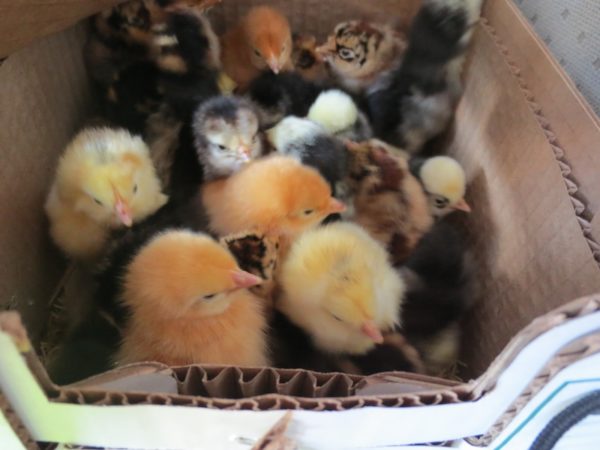
 Love at First Sight!
The postal service delivered 25 pullets (baby girl chicks) on Monday, April 8. Hollis Hillhouse, our chicken volunteer trainer, triaged our baby chicks in their cardboard corral. All of our 60 chickens will come to roost on Governors Island by May 25!
We expanded the number of breeds to include some with tall feathers coming out of their heads, 5 clawed feet , basket shaped combs…..
4 Light Brahmas
4 New Hampshires
4 Salmon Faverolles
2 W.C. Black Polish
2 Golden Polish
3 Lakenvelders
4 Golden Wyandotte
3 Buttercups
In addition to our new pullets, and the 2 kids (baby goats) on the way, our bee hive and the interactive worm nursery, we are currently on a rabbit hunt. … stay tuned….
Sandy Soil
What effect did the floodwaters of Sandy have on Earth Matter compost? We sampled it in January and sent a sample to the Cornell Nutrient Analysis Laboratory for heavy metals and soluble salt tests. A similar sample was sent to Adirondack Environmental Services to test for PAHs (polycyclic aromatic hydrocarbons), PCBs (polychlorinated biphenyls) and mercury. We are grateful to Lydia G. Marquez-Bravo at the NYS DOH, and Hannah Shayler and Murray McBride at Cornell University for their assistance interpreting results. None of our test results raised concerns (hurrah!).
One expected natural effect of exposure to sea water is the deposition of salt (sodium chloride). In Earth Matter compost the low soluble salt result (0.07mmhos/cm) indicates that any salt left behind by the floodwaters is attached to exchange sites in the organic matter of the compost and is not available to plants.
In soil, by contrast, salt is more likely to be dissolved by rainfall and made available to plants. This does allow salts to be washed out of soil over time. Adding gypsum (calcium sulfate) is a way to get more calcium into the soil and displace sodium, if necessary. On Governors Island gypsum has been applied to lawn areas.Grasses and weeds are sprouting, and most shrubs and trees are budding. An exception is our trio of pine trees at the Center.
It is likely there will be no toxic impacts on Earth Matter crops grown in our compost. We will continue to monitor the effects of Sandy by planting in both pre and post Sandy compost for comparison. We have submitted new samples of the affected compost to test to see if our level of soluble salts has changed.
The Healthy Soils/Healthy Communities Project has been studying the effects of contamination in urban garden soils for the last four years and seeks to broaden the understanding of Sandy’s effect. Consider taking your own sample for testing and sharing the results with Hannah Shayler at has34@cornell.edu. For more information on submitting samples contact Brooklyn College or Cornell University. To learn more about the Healthy Soils/Healthy Communities Project and download informative, accessible fact sheets to share click here.