
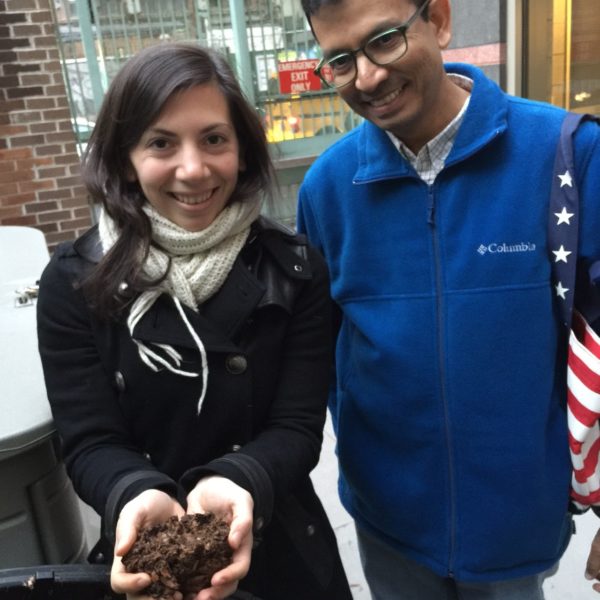
Lydia and her Advisor, Dr. Ajoy Sarkar show off the muslin (cotton) composting process in FIT’s 3-bin system.
Lydia Baird first volunteered at Earth Matter’s CLC in 2014, as part of her quest to find a suitable muslin composting system for her College, the Fashion Institute of Technology (FIT). Located in Chelsea, Manhattan, Lydia envisioned a campus-wide waste reduction system for recycling muslin. Many FIT classes consist of students creating clothing designs and “draping”. A voluptuous amount of unbleached muslin (100% cotton fabric) scraps are generated by these student projects.
Lydia and her advisor, Professor Dr. Ajoy Sarkar, impressed upon Charlie and I, that FIT’s culture, from the top administration down, embraces recycling, sourcing materials responsibly, and sustainably. This recycling tenet is woven into all aspects of the curriculum. We noted that the FIT campus has abundant cans + bottles, paper, and landfill waste station clusters. FIT is looking into contract with a women’s collective in India to supply their muslin needs. This partnership will also assist in FIT’s quest that their cotton grown is pesticide free.
Lydia applied for two grants to compost muslin, and, won both grants! The FIT Sustainability Council Grant and FIT Think Big Challenge & Clinton Global Initiative University Award.

Muslin is the carbon source for FIT’s tumber (bin 1 and 2).
Currently 100% of the student project-generated muslin is collected in bins placed in the classrooms. Muslin is the carbon source for FIT’s tumbler (bin 1 + 2), and “Garden Gourmet” (bin 3) compost system. It is conveniently located in an inner courtyard.
Before muslin swatches can be incorporated into the recipe, it has to be shredded, just like other plant materials (stop, chop, and drop all material, the size of your hand or smaller!). Muslin has relatively short fibers – ideal for the decomposition process. FIT agreed to “outsource” a company to shred the muslin. As the student-driven compost program proves it is “here to stay”, it is hoped that FIT will invest in a shredder of its own.
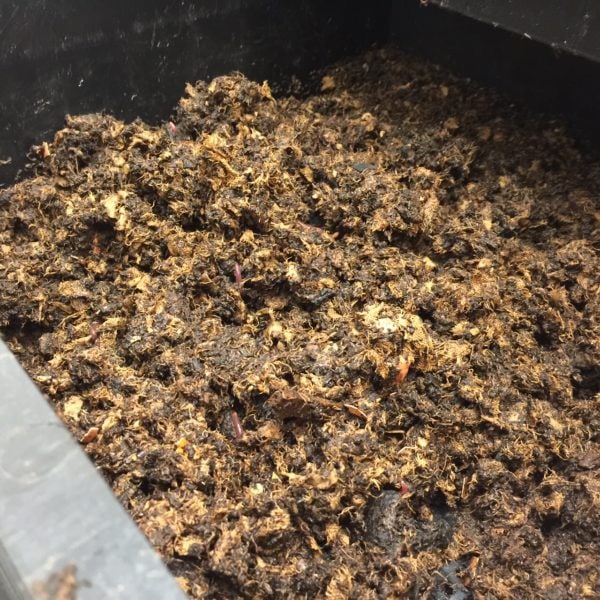
Red wigglers help with the decomposition process.
The compost team is comprised of students. They volunteer for all aspects of “feeding” and maintaining the compost system. Food scraps are collected from FIT’s dining hall for the nitrogen source of the recipe. In all stages of this mesophilic decomposition process, red wiggler worms help DEVOUR the fibers! The finished compost is rich in worm castings. This spring, the compost will be applied to FIT’s “dye” garden on their rooftop.
Earth Matter looks forward to partnering with FIT’s compost team to showcase this unique muslin composting system this spring. We will add muslin composting to our Compost Promenade’s variety of composting techniques and devices. The Promenade’s purpose is to highlight that there is no one “best” way to make compost. Rather, to ask, “Which system may be best for you and yours?”
Lydia is currently in her last semester. She is working to ensure that “passing the torch” of this muslin compost pilot to the underclassmen team of students is successful. A third grant has been submitted and Lydia and the team are waiting to hear back.
Three cheers to Lydia whose design for her fashionable colleagues is to view composting as “haute couture”!
Lydia writes about sustainable design on her website: www.egosumterra.com.
By Marisa DeDominicis