
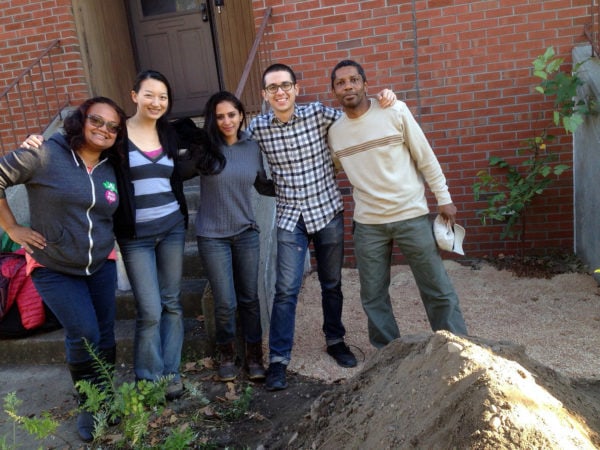
 Last fall, a team from the organization Just Food joined us at Earth Matter’s Compost Learning Center on Governors Island to lay down a “mushroom bed”, or spawn bed. We spoke to Just Food’s Jorge Cubas about what it means to create a mushroom bed, and what can be offered and accomplished by doing so.
Jorge Cubas interviewed by Bill Koehnlein
Earth Matter: You are spearheading the mushroom gardening project at various sites around the city. Can you tell us something about that?
Jorge Cubas: This first year, Greg Anderson and I are installing mushroom beds at test sites in NYC with the intention of offering City Farms workshops at these community garden/urban farms as early as the upcoming Spring season. The workshops would cover the creation of mushroom beds, companion planting, harvesting and maintenance, etc. Through these workshops, we will support our partners’ programs, markets and ultimately, soil remediation efforts.
We have recruited a group of people who we will dispatch as mushroom trainers to facilitate workshops, monitor the progress of our mushroom beds and create new mushroom-related projects within their communities. Gradually, we hope to grow a network of mushroom gardeners and build up to more advanced forms of cultivation. This will culminate in an economic development model around urban mushroom cultivation that will focus on utilizing waste streams and minimizing reliance on fossil fuels, while preserving natural resources (especially water).
EM: So what are you trying to do? What are your goals, your objectives?
JC: We see the mushroom bed as the first step to creating a mycological landscape in urban agriculture. Our long term goal is to build a network of sites and individuals who, in being very familiar with mushroom gardening, will have the capacity and knowledge to participate in a comprehensive mycoremediation effort in the future. For this, Just Food and its partner mushroom sites will need to pool many resources; we believe that a strong network of mushroom growers will serve a solid foundation.
EM: With various mushroom beds at sites throughout the city, why cultivate at Earth Matter?
JC: I think the short answer to this is why not? On the one hand, the process of growing mushrooms is a process of composting. Generally speaking, most cultivated gourmet mushrooms are saprophytic, which means that they rely on decomposing materials to carry out their life processes. It is not uncommon to find thick ropy threads of mycelium in a pile of woodchips or compost. Under the right conditions, this mycelium produces mushrooms. In this vein, the folks at Earth Matter are already mushroom cultivators!
Mushroom beds are also called spawn beds. The beauty of this technique is its versatility. Once fully colonized with the fungus, the woodchips from these beds will be used in different ways at each site. At Earth Matter, we plan to experiment with companion planting. Basically, we can use the mycelium from the mushroom bed to inoculate newly planted crops in the Spring. The result, according to the literature that inspired us, will be a flush of mushrooms and a boosted yield in crops. Additionally, spent mushroom waste is excellent composting material, especially in vermiculture. Red worms feed on the bacteria and fungi that actively break down waste. Spent mushroom waste is essentially a plethora of rich nourishment for worms in vermicompost, so we would love to experiment with this as well.
Finally, it is very important to the resiliency of our project that the individuals involved be particularly interested in mushrooms. Personally, Marisa’s [DeDominicis, Earth Matter Director] and Anandi’s [Premlall, an Earth Matter apprentice] enthusiasm is reason enough to trust that this work will bring value to Earth Matter.
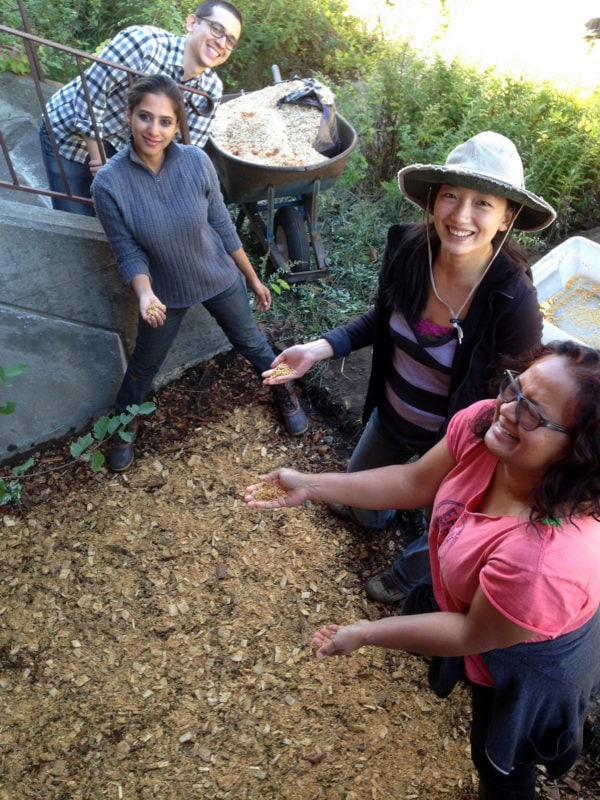 EM: This will be an ongoing project, then…a long-term collaboration?
JC: Greg and I hope for this to be a long term collaboration. Once our mushroom bed is fully colonized, the Garden Giant will naturalize at the Earth Matter site and remain there for quite some time. Its mycelium will spread underground in search of more matter to decompose and the spores from the mushrooms will be carried by the wind to farther reaches of the area, settling on a pile of woodchips, perhaps, and germinating. With Marisa, Anandi and others, we plan to continue learning about the fungus life cycle and gradually apply different methods that will further Earth Matter’s mission and work.