
 By Marisa DeDominicis and Bill Koehnlein
Chickens, as most Newsletter readers probably know, reside year-round at Earth Matter’s Compost Learning Center on Governors Island, and from late Spring to early Fall goats and rabbits make the Center their warm-weather home as well.
But do you know that there is another group of year-round residents at Earth Matter?
Tucked away on the more secluded “Staff Path”, is our own colony of Apis melliifera, otherwise known as the honeybee. More precisely, our bees are A. mellifera carnica, a subspecies of A. mellifera, known more commonly as the Carniolan honeybee. They are native to Slovenia, southern Austria, and several of the countries of East Europe and the Balkans.
Although honeybees are not native to the Americas, honeybees, like the other species in the genus Apis, play a crucial role in the pollination of trees and plants, and in the process create beeswax, nectar and honey, as well as bee pollen and propolis. Honeybees’ “genetic wiring” is all about “beeing” industrious and community-minded, their nature and their gifts have made beekeeping a favorite activity at Earth Matter.
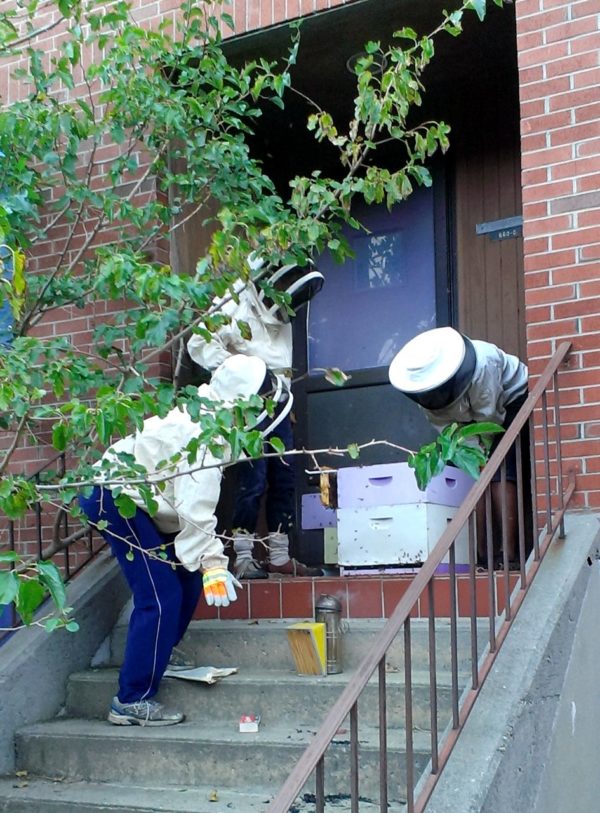
We are part of a community of New York City beekeepers. This past May, we joined Bronx beekeepers Roger Repohl and Karen Washington in selecting a NYS-raised queen, in the hopes that this colony that has been raised locally, will be better suited to our local conditions. Our apprentices set up the new hive at the top of an outdoor stairway to facilitate their “bee line” flight pattern, and to cut down on the amount of contact with human visitors. Shafina Rahim named the hive “MayBees”.
The MayBees feasted on nectar and pollen from flowering plants all over Governors Island including a new mini-biome established in the new park this past season. This additional parkland has increased GI’s botanical diversity—a wildflower understory with a good variety of tree species. The bees were provided with an abundance of nectar and pollen. In August, 53 pounds of honey was extracted from the hive.
With the end of Summer and temperatures starting to drop, Earth Matter began to prepare the bees for the cold season. Fall maintenance consisted of moving the hive further back into the building recess by one foot in order to provide a better wind and weather break. We also conducted a varroa predatory mite check and, fortunately, did not find a very high number of mites on our varroa board. As a result, we chose not to treat the colony with any miticide—which does get into the honey. Some apiarists assert that such pesticide use ultimately weakens the hive population and compromises the bees’ health, in much the same way that overuse of antibiotics can depress human immune systems.
We also consolidated the number of frames in the hive but left plenty of “stores” (about 90 pounds of honey) to eat, as bees are generally inactive in cold weather. Honeybees stay inside the hive during the Winter, occasionally coming out for short periods, but only when the outside temperature rises to about 50 degrees F.
Our vigorous MayBees hive contains 15,000 worker bees, who will cluster around the colony’s queen in the innermost frames of the hive, creating a “ball” the size of a cantaloupe, fanning their wings to keep the temperature in the cluster around 95 degrees F at all times. (Worker bees are always female, and have a multitude of functions, including hive maintenance, nectar gathering and processing it into honey, and protecting the hive. The males—called drones—mate with the queen; we are not sure what else they do. They live in the hive until Fall. Drones do not sting; only the workers do.)
So while we will see very little of our MayBees over the next few months, we hope they will emerge from the hive in the Spring, strengthen themselves through flight, nectar gathering and warm breezes, and will once again take on the task of continuing the Governors Island parkland pollination cycle. And maybe, if all goes well, we will have additional hives in the days to come.
[Marisa DeDominicis is the Director of Earth Matter and Bill Koehnlein is the Newsletter Editor.]