
 By Albert Carreras
Turn off all lights when you leave a room and the faucet when brushing your teeth, use public transportation, reduce and recycle your waste, and compost your organics. All these actions are part of a long list of tips on how to go green and reduce your ecological impact. Now you can include a new, fun and nutritional choice: shuck oysters.
Oyster shells can be diverted from regular trash waste and managed as a particular organic waste stream just like other food scraps such as fruit and vegetable peels, coffee grounds and tea bags, napkins, garden trimmings and grass clippings. Due to their particular calcium carbonate composition, oyster shells cannot be biodegraded into compost. However, they can be used for other beneficial environmental purposes. For instance, oyster shells are a perfect substratum for reef restoration; crushed oyster shell can be used to create nesting habitats for threatened seabird species; and ground oyster shell is an excellent organic calcium source for gardens.
Earth Matter NY has been one of the leading organizations involved in removing organic waste from landfills and raising awareness about composting and its benefits, and encouraging community participation in New York City is central to its project. This past year, Earth Matter partnered with the New York Harbor Foundation to launch an Oyster Shell Collection Program that will provide the Billion Oyster Project (BOP) with oyster shells generated and collected from a number of seafood restaurants in the city. The BOP is a long-term, large-scale plan to introduce one billion live oysters to New York Harbor and its tributaries and esturaries over the next twenty years and to restore and maintain the beds. This project not only will have a huge positive environmental impact, but will strongly support Earth Matter’s mission of raising New Yorkers’ awareness and knowledge of urban ecology, sustainable economy, and the importance of both individual and community responsibility for taking care of our planet. The Billion Oyster Project will educate thousands of young people about ecology and the economy of our local marine environment, and Earth Matter, within the Oyster Shell Collection Program, will teach restaurant workers, patrons, and oyster shuckers about the varied benefits of reusing recovered shells, separated at the source.
This new program will also become part of Earth Matter’s ongoing educational dialogue with visitors to Governors Island about zero waste and the close loop of organic materials, where all organic waste is simply a link among other interconnected ecological processes.
Oysters do not need to be artificially fed; they feed themselves by filtering nutrients from the water. As such, the Oyster Shell Collection Program and the BOP’s restoration initiatives will ensure that thousands of oyster shells will not be treated merely as waste. Instead, these shells will provide vitally important ecological benefits, including continuous water filtration and water cleansing—and therefore a significant improvement in water quality; a renewed habitat for numerous marine species, that will bring expanded local and regional biodiversity; and wave attenuation, which will help protect New York Harbor from coastal erosion. Noteworthy is the fact that the program is a vital contribution to a sound and sustainable ecosystem.
So just think: next time you are enjoying a plate of oysters on the half shell at your favorite seafood restaurant you are also being an active advocate for sustainability, part of the “Shucking Revolution”—and in an enjoyable snd fun social setting! Restaurants participating in the program can be found on the BOP website.
[Albert Carreras is a recent graduate of the Earth Matter composting apprenticeship and a new member of its team. He is coordinating the Billion Oyster Project shell collection program.]
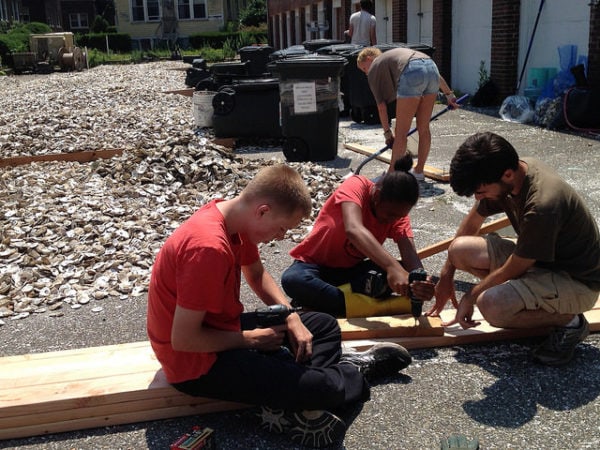
Pictured above: Eric Weimer, Mia Luna and Albert Carreras